 What profession besides writing can you think of that requires the kind of incredible bravery (or is it masochism?) that writers must muster every day of their writing lives? Okay, firemen, cops and fighter pilots. But besides them? I’m not even making the distinction between Indie and Trad writers for this one because one thing is true across the board for every writer and that is that it takes guts to write your heart out—reveal the depths of who you are and what you value—and then drag it up the flagpole and invite people to rate it. And while you’re hoisting your precious dearest baby up the flagpole, you can see out of the corner of your eye, a few people are already loading up their bows and cocking their guns. No matter how great you think it is or your editor has assured you it is, you know there are always going to be readers out there who won’t like it. And it doesn’t matter that it “wasn’t their cup of tea,” or that it wasn’t the genre they usually read, or that they admit your main character reminded them of their ex-husband in a nasty divorce—they’ll still come at you with both barrels loaded and one in the chamber.
And yet.
Knowing this—and there’s not a published writer out there who hasn’t felt the sting of a bad review—we still do it. We not only do it, we do it everyday, we do it like we can’t not do it, we do it like we’re being paid to do it.
Weird, huh?
What possible other passion could be so fraught with the possibility of humiliating rejection? I suppose actors might be one but since the days of slinging tomatoes and rotten fruit at the stage are over (at least, mostly) perhaps not. Even publishing a couple crappy reviews about a play or a gallery opening can’t compare with hundreds (or more) of average readers with an opinion. A newspaper reviewer may be negative but Average Joe who feels you wasted his $2.99 on your e-book can be personally hostile. We writers constantly work the online e-channels for marketing purposes (since that’s where our books live, on cyber shelves) and which makes them—and us—static targets for all kinds of whack jobs who are easily distracted by a big-ass bullseye.
Who knew when you signed on to be disrespected by your family, belittled by your coworkers and pitied by any and everybody who knew you were writing a book that, on top of it all, you’d have to deal with hate mail from Sri Lanka when you finally finished the damn thing? And then? You sat down and began the whole process all over again. In fact, you couldn’t stop yourself from sitting down and beginning it all over again. (Honestly, is there any other reason why we keep writing other than we can’t not?) Most of my writer friends accept the second-class citizenship status of a novelist in today’s world—especially a self-published one—and they accept the possibility of the public slings and arrows of annoyed, unhappy readers too.  Their advice is: grow a thicker skin or stop reading your reviews. Of course, that means you have to stop reading the good ones, too, and while I don’t exactly live for the good ones, they definitely add a cherry on top of my day and I’d hate to create a hard and fast rule requiring me not to look at them. I think it makes more sense to read the reviews with an ear for learning something that might make your book better, or to detect if possibly the reader is a lunatic (all caps are often a give-away), but not to take it too seriously. The last thing you want to do is approach your keyboard for the next book afraid you’re about to write something someone won’t like. Trust me, that’s guaranteed. Let. It. Go. And of course, the absolute best advice I’ve heard about bad reviews however you process them emotionally: don’t respond. I don’t care if they misunderstood what you were doing in the book (you should have been clearer) or if they skipped over the bits that would’ve clarified the problem (you should’ve make it more interesting so they didn’t skip). Just let them have their say and hope to bury the review under fifty positive ones. It’s all you can do. Oh, yeah. And maybe have learned something. That’s always nice.
Because Avocadoes Need Plenty of Sunshine, That’s Why
 Like many people from my generation I have a few personal heroes to whom I look to for inspiration. I know everyone is flawed and everyone screws up here and there and the hero I want to highlight in this post absolutely did, (for one, she ditched her only child in order to go off and have her amazing life) but, while I couldn’t do it myself, in a hard-to-describe-way that just made her dossier that much more fascinating to me.
Whenever I talk about Beryl Markham—and I do it not infrequently—I always mention the Avocado Farm. In some ways, this seemingly insignificant and certainly boring chapter in the famous aviatrix’s life engages and intrigues me more than any other.
First a little background: Beryl Markham was a British citizen born in 1902 and moved to Kenya as a toddler. Her childhood, depicted briefly in the film “Out of Africa” as the wild-child “Felicity” tearing up the countryside on the outskirts of Isak’s Dinesen’s farm was singular in many ways, not the least of which was the fact that she spent most of her time with the Nandi natives training to be a young male warrior. Her mother, horrified at what she considered primitive conditions in 1904 Kenya, fled back to England, but little Beryl wouldn’t budge. She was beautiful as all great heroines must be, strong-minded and smart. A natural with horses, she became the first licensed female horse trainer in Kenya. Her lovers included Bror Blixen, Dinesen’s husband, Denys Finch-Hatton, Dinesen’s lover, and Prince Henry, brother of King George VI. She learned to fly with Tom Campbell Black (both Finch-Hatton and Black died in plane crashes) and was the first person to fly the Atlantic east to west in a solo non-stop flight which she did in spite of prevailing Atlantic winds, fog and almost total darkness.
On top of all that, she wrote a book. An amazing book. “West with the Night.” To give you an idea of her ability as a writer—up to this point undiscovered—here is a comment on the book in 1942 from Earnest Hemingway—notoriously sparse with literary praise:
“I knew (Markham) fairly well in Africa and never would have suspected that she could and would put pen to paper except to write in her flyer’s log book. As it is, she has written so well, and marvelously well, that I was completely ashamed of myself as a writer. I felt that I was simply a carpenter with words, picking up whatever was furnished on the job and some times making an okay pigpen. But this girl who is, to my knowledge, very unpleasant…can write rings around all of us who consider ourselves as writers. The only parts of it that I know about personally, on account of having been there at the time and heard the other people’s stories, are absolutely true. So, you have to take as truth the early stuff about when she was a child which is absolutely superb… I wish you would get it and read it because it is really a bloody, wonderful book.”
So I hope I’ve set the stage for you to see what an astonishingly incredible person Markham was. A super nova in every sense of the word. Which is why the Avocado Farm stage always intrigues me to the point that I cannot let it go. I keep mulling it over and trying to make it fit into her biography—and maybe my own?
 You see, after Beryl had done all these amazing things and was a mega-celebrity on all continents worth mentioning, she married Raoul Schumacher and moved to California where the pair ran an avocado ranch. Mary S. Lovell’s book “Straight On Till Morning” says that she and Raoul spent their days drinking and watching the avocados grow. After years of intense international celebrity, of partying hard with the famous and the infamous and filling world headlines with her world-firsts accomplishments, she spent what we might consider today to be her peak years drinking herself to sleep every night and staring into space for nearly ten full years. She didn’t party or socialize. She didn’t do anything except fight with her third husband and drink.
And then.
In 1952 she left the avocados and the third husband and returned to Kenya. She started raising and training horses, and from 1958 to 1972 she was the most successful trainer in Kenya, winning all of the major racing prizes. Before she died in 1986 at the age of 84, West with the Night was republished and became an instant best-seller. 
So, okay. Back to the Avocado Farm. What was that? Do we all have a period in our lives where we’re growing avocados before we get back to being amazing? Or, as I suspect with my own biography, are our whole lives one big avocado farm with a few interrupting glimmers of awesomeness peeking through here and there?
Incredible Beauty and Sheep Farts
I’m finding myself in a weird wedge of time at the moment where I’m fairly obsessed with the book I’m currently writing, a time-travel romance/suspense set in Heidelberg, Germany in the late 1600s. I find I am driven to wallpaper my world: house, website, blog, Facebook with images of Heidelberg. You know how it is when you’re obsessed with something, you crave seeing it everywhere? Well, that’s how I feel when I see the silhouette of the ruins of Heidelberg Castle above the Altstadt or the Church of the Holy Spirit Domplatz or hell, even cobblestone streets. While I am full into this other world (and loving it) I find I have little to no energy for creating a fresh blog post. (And frankly the new puppy hasn’t become any less demanding either!) Ergo, I am turning once again to Adam Jones-Kelly and his ever informative and vastly entertaining blog series OnSite: Eating, Sleeping & Coping Around the World. Today’s post from Adam helps satiate another obsession of mine, all-things-NZ, and I’m confident you’ll love it as I did.
 New Zealand is often referred to as God’s own Country or The Paradise of the Pacific. Make the three hour drive from Auckland north to the Bay of Islands and it’s easy to understand why.
New Zealand is a nature park that accidentally became a country. Her appx. 10,000 mile long coastline sports some of the most pristine beaches in the world. One fifth of the North Island and two thirds of the South island boast mountains so spectacular they jockeyed for attention with the special effects in the Lord of the Rings trilogy. New Zealand has an incredibly diverse landscape, home to a tropical paradise in the north, with glaciers and some of the world’s best skiing in the south.
Only 4.3 million people live in New Zealand, with a population density of about 13 people per square mile. (The number is 30 per square mile in the United States, 244 per square mile in Britain and a whopping 6,500 per square mile in Hong Kong.)
New Zealand’s citizens share space with an estimated 40 million sheep, and the country’s biggest pollution problem is the methane produced by sheep farts. In 2008 the government even proposed a tax on farmers whose sheep passed too much gas. (I don’t think they ever figured out how to measure this, but I’d sure love to have seen the debates in parliament!)
What this all demonstrates (besides the fact that politicians are all completely nutty) is that New Zealand is a remarkably untainted natural oasis. “God’s own country” is perhaps an insufficient description of this stunning land.
I won’t make it to the South Island this trip, but I have been lucky enough to see much of the North Island, beginning with my drive up the coast from Auckland to Paihia in the Bay of Islands.
Encompassing some 150 islands, many of which still remain relatively unexplored, The Bay of Islands is a marine paradise home to whales, stunning beaches and lots and lots of playful dolphins. It was the latter Soo and I couldn’t wait to see. “Swim with the dolphins” tours are as intricately linked to the Bay of Islands as porn stars are to Tiger Woods.
The drive North from Auckland takes you past Ruakaka Beach, through towns like Waipu, Warkworth and Whangarei, and I think we stopped at every one.
In Warkworth we enjoyed an absolutely wonderful meal at a small café called Ginger. I had a traditional New Zealand mince ‘n cheese pie, while Soo devoured a steak sandwich she described as “to die for.” (I tried it, and agreed – I was almost willing to kill for another bite.) We also had a perfectly scrumptious “ginger crisp” for dessert, which was nearly good enough to make me forsake pavlova as my favorite kiwi treat.
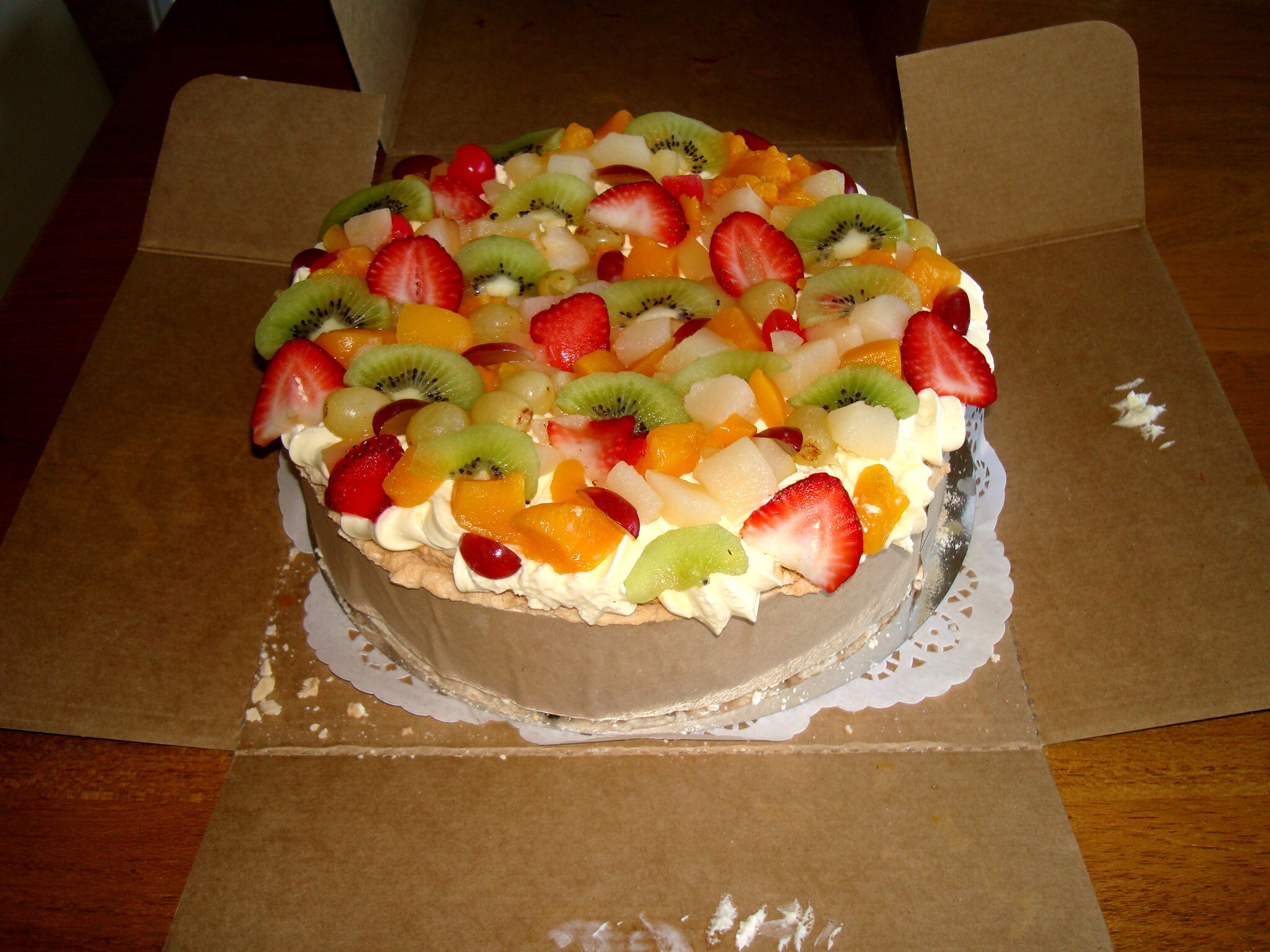
The incomparable pavlova
From Warkworth we continued north to Whangarei.
Whangarei (pronounced “fongaray”) is a delightful little coastal town, but the Whangarei Falls steal the show. Passing through town without visiting the falls is like reading Playboy “just for the articles;” No one really does it. It’s described as the most photogenic waterfall in New Zealand, and amazingly there’s never anyone else there. I’ve visited three times, and almost always have the area all to myself.
But, beautiful as The Falls were, dolphins were our goal, so on to Paihia we went.
Paihia is a bustling, somewhat touristy seaside town known as “The Jewel of the Bay of Islands,” though this entire region is so gorgeous that this is much akin to pointing to one M&M in a bowl of M&M’s and confidently proclaiming “That, my friends, is THE M&M of M&M’s!”
We dropped our bags in our room at the Paihia Beach Resort (Soo and I both strongly recommend this wonderful boutique hotel) and headed for the wharf.
We choose the Explore New Zealand tour group for our dolphin adventure. They took us, and about 30 other eager tourists, out on the stunning azure waters of the Bay in search of the graceful mammals, and it didn’t take long to find them. It was almost as if the dolphins were looking for us. They couldn’t wait to swim up alongside out boat, and were literally jumping out of the water in anticipation of the happy tourists entering their world.
Soo and I were delighted, and snapped about 300 pictures. We took turns jumping in the water and swimming with the immensely playful pod.
The dolphins were thrilled when you’d dive down with them or try to keep pace as they raced along beside you. They’d dart, jump and splash along with all the energy of a 6-year-old kid. Their joyful innocence was contagious.
 Soo and I spent about 30 minutes each in the water with them. The dolphins are playful and FAST – trying to keep up is exhausting. But it was the most fun exhaustion we’ve ever experienced.
There was nothing we could do to compete with the day we’d just had. We sufficed with going out for seafood (not dolphin) and talking endlessly about our wondrous day. We were on such a high from the swim that just about any food would do.
Regrettably we found 35 Degrees South, a place where depressed sea life goes to die. Our waitress, who spoke no English – not even Kiwi English – may or may not have brought us what we ordered. Whatever it was tasted like the inside of my colon. Soo’s pan-seared scallops could have doubled as rat poison, and they even managed to make my fish ‘n chips taste like sweaty foot. I’m convinced they fed us whatever had died in their filthy aquarium the week before.
We couldn’t eat it.
We tried instead Kava, across the street, and were rewarded with food almost as delectable as the view from this ocean-front eatery. Perfect end to a perfect day.
I’ve yet to be assaulted by one of the famed sheep farts, but I’m pretty sure one of those dolphins let one go while I was diving. Didn’t matter – this was one of the coolest days of my life. I’ll never forget it, or stop appreciating how lucky I was to experience it.
Being Kiwi
The combination of a new puppy in the family (relentless!) and the fact that my guest blogger today, Adam Jones-Kelly, is a wonderful writer, blogger and world traveler (since he was seven years old) has me handing over the helm of my blog yet again this week. For my readers who are drawn to all the travel-love I often indulge in here—plus any Kiwis in the group!—today’s post will be a total delight. I encourage you to follow Adam’s blog at OnSite: Eating, Sleeping & Coping Around the World. He really has a razor sharp take on the places he visits—always spot-on, VERY funny and insightful—and his photos are stellar. I’m partial to his Kiwi post, presented here, because of my love affair with that country. His photos in this post, fairly recently taken, had me fumbling for my Amex card until my husband reminded me of the likely effects of taking a puppy that hasn’t been housetrained yet on a 16-hour Air New Zealand flight. Enjoy!
Brendan Gill once wrote “Not a shred of evidence exists in favor of the idea that life is serious.”
The Kiwis were apparently paying attention.
New Zealanders are an irreverent bunch, playful, adventurous, and happy, quite possibly the happiest people I’ve ever known. Kiwis don’t just live life, they attack it, with a wink and a grin.

Rangitoto volcano across from Auckland Harbour
The approach to the world’s highest cliff jump has a couple of somber warnings for wary visitors, carefully placed along the gravely walkway.
This is not surprising, since one side of the walkway is a sheer cliff, off which you’d enjoy a 300-foot plummet before face-planting into the canyon below at 100 miles per hour.
What is surprising is that the signs neglect to mention the certain and painful death lurking mere inches away, instead alerting passersby to be on careful lookout for gnomes.
Life here is not real serious.
My favorite all-time Kiwi billboard was selling itself, and proudly proclaimed that it “Stands out like dog’s balls.”
I love Kiwis.
Before leaving Queenstown we all agreed that a ride on the Skyline Gondola to the top of Bob’s Peak was in order, and a visit to Fergberger a must.
So, still peeling so extravagantly from my Bora Bora sunburn that I looked like a leper begging for coins, we queued up for the five minute ride up the mountain. Though shedding skin in such profusion does garner you a great deal of personal space, the line was long, so Soo and I amused ourselves by peeling large flakes off my arm and depositing them at the feet of horrified tourists.
Once to the top we quickly forgot all thoughts of tormenting fellow travelers, so magnificent were the vistas on display as Queenstown spread out before us, enveloped by the majestic snow-capped peaks of the Southern Alps and kissing the shore of Lake Wakatipu.
It’s catch-your-breath beautiful, and we happily settled in at the bar at the Skyline restaurant to enjoy a drink while staring out the window. (The restaurant itself is a buffet, allegedly a really poor one, and costs a fortune. We failed to come up with any reason to eat there since lounging in the bar area afforded you the same views.)
That out of the way, our last Queenstown must-do was lunch at Fergberger. The hole-in-the-wall joint making the biggest, juciest burgers you’ve ever seen, started a decade ago because the owner, Ferg, believed that locals deserved a spot to eat when they were “drunk to hell.” Their website pleasantly notes that in the early days the restaurant was guilty of swapping “chips for tits.” Ah, Kiwis.
There’s always a line out the door, and once having ordered it takes 20 minutes to get your burger, but it’s mouth-watering oh-so-worth-it deliciousness. Among my favorite menu items are the Sweet Bambi, the Cockadoodle Oink, the Holier Than Thou, the Bun Laden (falafel, of course) and the Cock Cajun burger, which apparently has nothing to do with sex, though after eating one you’ll need a cigarette. I sure did.
We unhappily departed Queenstown on Air New Zealand. (Unhappily because we were leaving, not because we were on Air New Zealand. It is, in fact, one of the world’s top-rated airlines, winning the 2011 Air Transport World’s Airline of the Year award for the second time in three years, but one that, being Kiwi, doesn’t take itself too seriously. And it’s perhaps the only airline on earth capable of convincing me to pay attention to the here’s how you fasten your seat belt, put on your life vest and find the emergency exit in the unlikely event of a water landing routine. Air New Zealand accomplished this by presenting the airline safety features in a video that incorporates Richard Simmons, 70s dance music, flight crew in nothing but body paint and the members of the national rugby team.)
It’s hysterical, completely endearing and utterly Kiwi.
The first few minutes of our flight, however, were less endearing.
My wonderful friend Jo is one of those people practiced at supervising everything around her, even those things that don’t really require supervision. The pilots on our flight unhelpfully declined to allow Jo to manage things from the cockpit, so she was left to fret about how they were doing in the back with the rest of us.
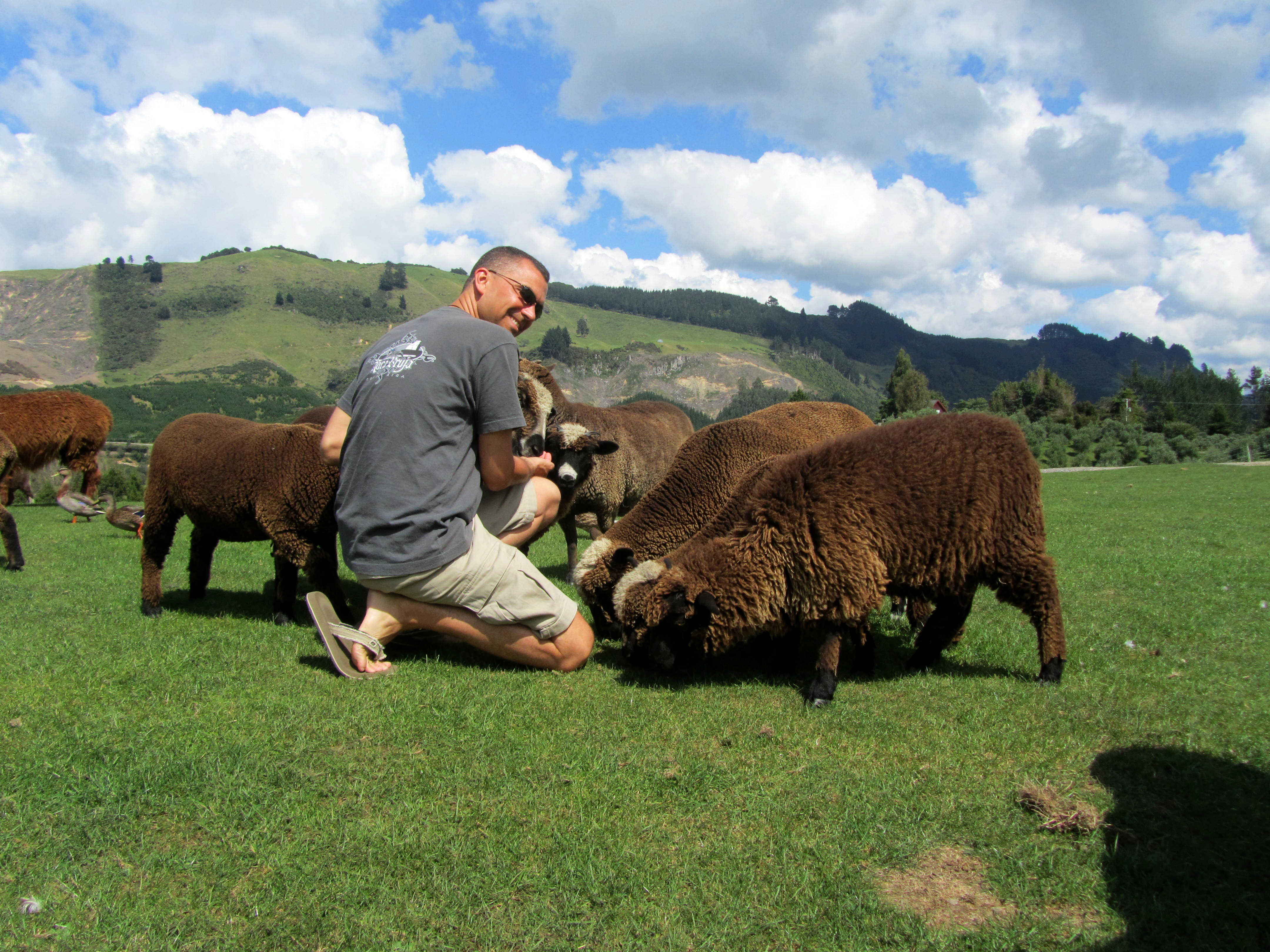
The author with a few of the 40 million sheep that make NZ home!
Regrettably, they gave us plenty to fret about for the first few minutes.
It was terribly turbulent upon takeoff, apparently not uncommon for this little corner of the world. (Airfare Watchdog’s list of The World’s Most Thrilling Airports puts Queenstown #2, noting that “Queenstown… lies below The Remarkables, a jagged mountain range seen in The Lord of the Rings. On descent, passengers may feel a sudden drop in altitude caused by strong downdrafts. Bird activity by the runway, as well as frequent bad weather and poor visibility, also make Queenstown Airport a real knee-knocker.”)
On takeoff, we got the sudden drop.
The pilot, to his credit, was racing for higher altitudes, trying to get us out of the chop. But before he could get there we hit one of those downdrafts, and the plane plummeted. Screams could be heard from passengers all around us, and poor Jo, who’d brought two of her daughters on the trip, but left her eldest, Amy, behind in Auckland due to work constraints, was utterly convinced we were all going to die. Jo touchingly and tragically later shared that her one thought in the panic of the drop was that she was heartbroken to leave Amy alone in the world.
As you will have deduced by the existence of this blog, the pilots recovered, and we made it to Auckland just fine. I do think they distributed a wee bit more alcohol on that flight than is usual, however.
Auckland, where I lived as a child, is probably my favorite city on earth. Not because it’s beautiful in the way Paris or Venice are beautiful, and not because it’s exciting in the way Queensland was. (It is beautiful, this city of sails, and of course has its own brand of excitement. But that’s not what you take away from Auckland. It’s the feel of the city, the very Kiwiness, that makes it my favorite.)
When we first lived here 30 years ago my father used to rail at the impossibility of finding decent Chinese food anywhere in Auckland. Now, half the restaurants in town are Asian, and they’re scrumptiously authentic.
 The city has changed, but it’s still Auckland. There’s still a family-owned fish & chippery on every corner, still a quaint dairy for every neighborhood. (A dairy in NZ is part convenience store and part old rural country store from our parents‘ early years. And they always have fresh, delicious ice-cream.)
On a typical Sunday afternoon in Auckland, the shopping malls are empty, the harbor full of sails. The landscape is dotted with extinct volcanoes, everywhere you look people are smiling and laughing, and it just feels like… home.
It occurs to me that so much of who I am today was shaped by New Zealand. For the past three decades, most of which I spent living in America, I’ve been busily being Kiwi, though I’m not sure I ever realized it.
And that’s made my life ever so much more fun. I’m so grateful for that part of me that never stopped being Kiwi.
And Then He Asked Me If I Had A “Plan”
Today I’m guesting a new friend and blogger, Julian Easterly, who is a travel writer who lives and works abroad and whose blog Between the Breaths you’ll want to check out after you’ve heard from him here. Like me, Julian is interested in why we travel as well as how travel affects us. Because he’s also a writer, he addresses the more complex aspects of travel that most people don’t typically think of, like: how does my travel affect others around me? I love the way he thinks and I’m pretty sure you’re going to appreciate it too. Here’s a snatch of “flash fiction” that combines the authenticity of true-life dialogue with that emotional powder keg that can be found only in a father and son going head-to-head. Enjoy!
And Then He Asked Me If I Had A “Plan”
The play by play for how I told my Dad I wanted to live abroad.
“You’ll fall behind in the job market!” Boom!
“How’d you plan to make live?” Smack!
“You graduated at the top of the class. Get grad school paid for!” Bam!
And finally the coup de grace: “Do you even have a plan?” Wham!
Even with a phone hot against my ear, I feel like Sugar Ray Robinson trying to parry and counter these punches.
I would like to hang up on the guy, but it’s my dad. It’s been about a month or two since we’ve last talked. I calm down.
I tell him again about my decision to wait for graduate school and proceed to recount reasons: youth; languages; the immediate shortage of cushy positions and lucrative tenured tracks.
Rushing of into a 6+ year Doctorate program could potentially waste a vital portion of my life that I will never get back.
Two years, I tell him. Two years to see if it’s what I want to do.
“Ok. But it sounds like you don’t have a plan.”
I take a breath, and admit “Okay dad. You’ve got me. I don’t have a full proof plan.” I explain to him that I have a little job teaching English, and a job as a cook in a restaurant I frequent, and that of course continuing coaching football helps.
“Sounds like minimum wage, son.”
Yea dad, I say, the pay won’t be the best.
“Where are you going to live?”
The conversation continues in this fashion: He asks a logical question, I answer with what information I’ve gathered. He sighs and tells me that I could do better financially back home. As this conversation continues, the validity of his words becomes clearer.
Listen to the words of people who love and care about you.
He’s right. Aside from rudimentary notes in an old notebook and pages I’ve filled with connections and promises from people I’ve met, I don’t have a concrete plan. Admitting that I did not deny the argument was my first step.
It’s necessary to admit the reality, yet despite it all, go through with it all. Work. School. Live. Discover how to avoid the goldfish bowl.
Demonstrate that you’ve put an effort to research.
I talked to Dr. Carino, Brennan, and Bates, I say.
“Your professors?”
Yea.
At the hour mark fatigue starts to set. I decide tell him that I sought advice from people with seats at those lucrative tenured jobs. Of course, they wished that I would go to graduate school, a year or so break for self-discovery wasn’t a bad idea. Dr. Brennan had even been taken a year off between the transition himself to travel and experience.
It’s hard to convince a man of experience with one sole voice, after all sometimes the harmony of a symphony mores more than the solo.
Find a common ground.
We discuss my dreams and my goals for some time. I can tell he can hear the excitement in my voice as I talk about the possibilities: graduate school abroad, teaching in Korea, farming in Thailand. All those connections with new cultures. I remind him of that trip to Cancun he and my mom had almost paid off and never left for. I tell him I’ve paid in work, and that I want to enjoy the opportunity.
Silence.
In concession, or rather a momentary retreat, he tells me softly, “No matter what you do, I will always support you son. I love you boy. Goodbye.”
Love you too, I reply. Peace.
We hang up the phone, and I sit on the bed, emotionally drained. I lie on my bed and wonder why my dad didn’t take that first trip abroad. What made him stop his payment? If he hadn’t, maybe he would understand why I was so passio—
I call him back immediately with so much I want to say, but I settle for a simple, Thank You that he accepts with explanation.
I promised myself I would get him to make that trip to Cancun one day soon. I had to. Because a simple Thank You doesn’t quite suffice for parents who exchange cruise payments for cribs and diapers.
Why Point of View Matters So Much
When my son was a baby and being fussy, my husband would sometimes hang him upside down by his feet and John Patrick would almost instantly become quiet, widen his eyes and stare about as if fascinated with his new upside down world. My husband usually said something like “alternative perspective” to  explain our baby’s reaction but the take-away was: sometimes you just need to look at the world differently.
I’ve discovered that that idea translates to grownups, too. I really believe that you can’t really see your world by sitting still (or upright). To see a thing (or a problem) properly, you have to get up, walk around it, squat down, close one eye and then move to the other side. The way an artist stalks around his model, squinting at her from every angle before attacking the canvas is, I firmly believe, how you need to tackle your life. I used to think that summing up what you’ve done and where you thought you were going—almost as if you had sixty seconds on the Oprah Winfrey program to tell the world about who you were—was an effective way to get a snapshot of your life. Kind of like the famous thirty-second elevator speech we’re all supposed to have. But like a lot of things that sound too easy, I don’t think a simple statement can cut it. I’ve come to believe that the effort of standing up and moving about your life to get a better view of it is essential. I bring this up for two reasons. One, I just read an awesome piece by Claudia Welch in this month’s Romance Writers Report called “Playing with a Full Deck” where she talks about identifying theme in your novels. She says, basically, that beyond the specific, obvious, theme which is evident in any one particular book, if you look at your work as a whole—all your series, your short stories, your stand-alones—you’ll find a theme that comes from the very heart of who you are and one that shows up in all your books in some form or another. I loved this exercise and was astounded to realize that all my books have me putting my protagonist on foreign soil or in an alien environment of some kind. I clearly have a “fish out of water” focus that finds its way into all my books. Now, the reason for that isn’t too earth-shattering (I’m an ex-military dependent and moved about the world relentlessly as a kid), but the fact of it, was. Knowing yourself and what drives you is always helpful when it comes to your work.

Looking down on the town of Freiberg, Germany
The other reason has to do with the fact that I just got back from an overseas trip with my husband and that now seventeen year old baby, and the experience impressed upon me yet again the amazing benefits of travel for perspective in your life. I asked my husband when we got back if he thought he might do things differently in his daily round now that we were back and he replied: “Of course.” See, it really is that obvious. It’s like stepping out of your body, out of your present lifestyle and being able to see, almost clinically, how you live “back home.” And that’s important because until you take the emotion out of it, until you step away and view it from an alternative perspective, you can’t see how many short cuts you’ve started to take, or how many habits you’ve created that don’t work. I hope my new point of view of how I live stays with me. But if it doesn’t, I know where I can buy a plane ticket to get it back again.
Empty Nesting is Not for the Faint of Heart
I swear to you, as God is my witness, that I turned my back to make my eight-year old son a peanut butter and jelly sandwich and when I turned around,  he had graduated high school and left for college.
This is not hyperbole.
Well, okay, it is. But I swear it feels like it’s true.
I cannot believe it’s nearly time for him to leave already. I can’t believe all the school pictures that I have been painstakingly placing in the photo albums through the years are now finished. I hold the final and last one in my fingers. This photo of him grinning–so self-assured!–in his tuxedo and too-long hair (a little senioritis rebellion) is the endcap for his school years that began with the mother’s morning out that he and I pretended was “real” school, because he went with a backpack and a snack and came home with praise from the “teachers” and excited reports about the other kids on the playground—particularly fascinating for an only child.
And now he’ll be “coming home” at Thanksgiving and Christmas. I feel like turning to my husband and saying: “Did you know there was an end date?” Why don’t they tell you that when you bring your little bundle of joy home from the hospital? “Hey, New Mom, word to the wise. He’s already plotting how to leave home.”
While it’s true I have a couple months yet before we pack John Patrick’s bags and shop for his dorm furniture, I already see previews of the life to come in how his older friends, home for the holidays last year, behaved (so grown up!) and in John Patrick’s impatience this spring with his last few months of high school.
I promised myself that I was not going to be one of those clingy mothers who refuses to let her child stretch his wings and fly the nest. I want my son to have an awesome college experience, maybe meet someone special who we’ll all grow to enjoy and love.
But until then, I totally reserve the right (when he’s not present to witness it) to be as sad and bereft as I know how to be at the ending to what was, honestly, the happiest and most fulfilling eighteen years of my life.
I know he’s literally counting the weeks until he goes. He’s anticipating the official beginning of his new exciting life. That’s as it should be. His Dad and I will wait for him to come home and report on his new world, his teachers, and new friends. Before he leaves again.
And it figures, the dog he leaves behind doesn’t even like peanut butter & jelly.
It’s A Scary World Out There
Long before social media put us into each other’s pockets and thoughts on a moment to moment basis, we had discovered that bad things were happening all over the world. We weren’t just hearing from the next-door neighbor that  somebody on our street had fallen down dead for no reason—we were also hearing about bizarre and awful things happening from as far away as Sidney, Australia. And when you hear about the problems of the WORLD in a steady stream, it starts to make you feel like bad stuff is constantly happening everywhere all the time.
I don’t think I’m unusual in my certainly irrational anxiety as I’ve watched my son go from one life experience to the next. Added to the worries of the last generation of “when she starts driving will she have an accident?” is the new concern: “will she have an accident and then be abducted by a serial killer because I know for a fact that can happen.” I’m not saying information is bad. We as a people long to know what’s going on with each other. Although Americans have been accused of only being interested in what’s happening in their own backyards, I think we’re all curious about the human condition wherever it is. It’s just that, instead of registering: “yep, that’s awful” over the discovery of a shocking story, we tend to gather up all the horrible, shocking stories (or rather the media does) and stack them up so high around us that all we see is a shocking and horrible world. And  that is the world we are sending our treasured sons and daughters off into. Can they help but be timorous after twenty years of watching Mom & Dad hold their collective breath every time they tried something new?
I don’t think my own parents loved me any less than I love my son. But they allowed me the freedom to experience life on my own terms that I have never been comfortable giving him. (When my father was stationed overseas in the early sixties, my little brothers and I freely wandered post-war Germany like scavaging souvenir-hunters, happily dragging home ancient hand grenades and unexploded bombs. Come to think of it, my parents may have been a little more laid back than most.)
Possibly it was ignorance. In those days, you didn’t hear the words “child molester” or commonly consider the possibility that dear old Uncle Ray might be inappropriately eyeing your son or daughter. It never occurred to you not to let your child ride his bike wherever he wanted to go, or even be gone for the full day if that’s where his adventures took him. Was it really a “kinder, gentler” time as George Bush, Sr used to say? Or was it just a time where bad stuff happened and our parents were oblivious to it? Are the fears we have today real? Or are they just a reaction to the flood of horror stories we now all hear about in the world community?
Finding Your Peeps Out in the World
 Finding your tribe, your peeps, your people. Not to restrict this important part of living to just that of writers, everyone needs community. While it’s true I belong to a nuclear family, an extended family, a parish, a neighborhood and a community of other high school student parents, it wasn’t until I left my corporate job and began to reach out to other writers that I realized I didn’t truly have a community of people who spoke my language. It takes all kinds to make a parish, for example, and that’s great. Because all the differences add valuable and differing skillsets and perspectives. But an artist laboring in a cubicle with corporate drones is not just a different piece of cloth in a multi-colored quilt. She is acting out a perverse situation of mismatch, misfit, and misconnection that adversely affects her on every level. The reason I continue to bang on this particular drum is because for most of my tenure in a corporate office, while I knew I didn’t really belong, I also didn’t see to the extent the attempt to fit in was bad for me. About two months after I left my job I went to a writers’ conference up in the mountains of north Georgia. There I met authors and writers of every stripe. I met geezers with boatloads of ancient trunk material they were self-publishing for their families, I met traditionally published authors who swaggered about accepting accolades for being incredibly lucky to be recognized as “real” writers, I met teens who only had scribbled poems and short stories they published on
  Facebook. I met writers a lot like me and writers nothing at all like me. And I was blown away by the fact that I felt connected to every single one of them. Even the ones I would’ve edged away from in an elevator or crossed the street to avoid. Even the obnoxious ones. Even the ones who shoved their self-published prose at me to prove within a few seconds that they couldn’t write very well. Even those people, I felt more connected to than the people I’d shared birthday parties and company picnics with for the five years previous. You don’t have to like every member of your family, but that doesn’t keep you from acknowledging (usually) that they are your family. Breaking out into the world of weirdos and writers, artists and losers, the pompous and the generous has lifted me up and filled me with a sense of belonging that I literally never had before.
 My peeps. My peers. I love being with them. I love talking to them about writing. I love recognizing the same struggles in them that I have with my own work. They understand me because they understand my passion. They understand my pain.
When I started blogging last year, I read all the advice about not doing a blog for writers because how can that be helpful in marketing your work? I worked so hard not to make this a writing blog but something readers might be drawn to (for obvious reasons). But writing is a passionate interest of mine so, like any other passion, I kept turning to it time and time again. It’s also the thing I’m attracted to in other people’s blogs—their take on writing, their perspective on writing schedules, their writerly worldview. When I realized that, regardless of what the social media experts preach, a writing blog is what fills me up and satisfies the parts that other topics can’t reach, I stopped trying to write for nonwriters. Not to take anything away from my parish or my family but when it comes to writing there is a singular language that only another writer speaks. Just like the expatriate I once was, I have to say sometimes it’s just so nice to relax with your own people.
Look Where You’re Going to Get Where You’re Going
 “It is a truth universally acknowledged…”
Not just a great first line, but a comforting thought. Don’t you love universal truths? Or truths we all buy into? I do because it means the fact that there are truths we all acknowledge as true means we can look to a universally accepted blueprint for how to live our lives. One of the places I look for these universal truths is at the barn. I look there because it’s one of my many opinions that there is no group of people on earth with more quotes relating to living your life than horse people. For example, there is the one about how to jump fences on horseback which, when you think about it, really applies to anything in life that you tackle that’s a little scary but worth doing. It goes like this: “Throw your heart over first, and the horse will follow.” The point about that one seems to be that if YOU’RE not sure you can jump that five-footer, you’ll inevitably translate that doubt to your mount and he’ll ensure you don’t jump it. When judges grade a jumping competition and a horse balks or refuses a jump, it’s the rider they look at for hesitancy. They tend to figure that if the horse is physically capable of jumping the fence but doesn’t—it’s pilot error, pure and simple.
Like anything in life, you gotta believe it before you can do it. And horses are amazing the way they can mirror how you’re feeling. But for all that, the point I 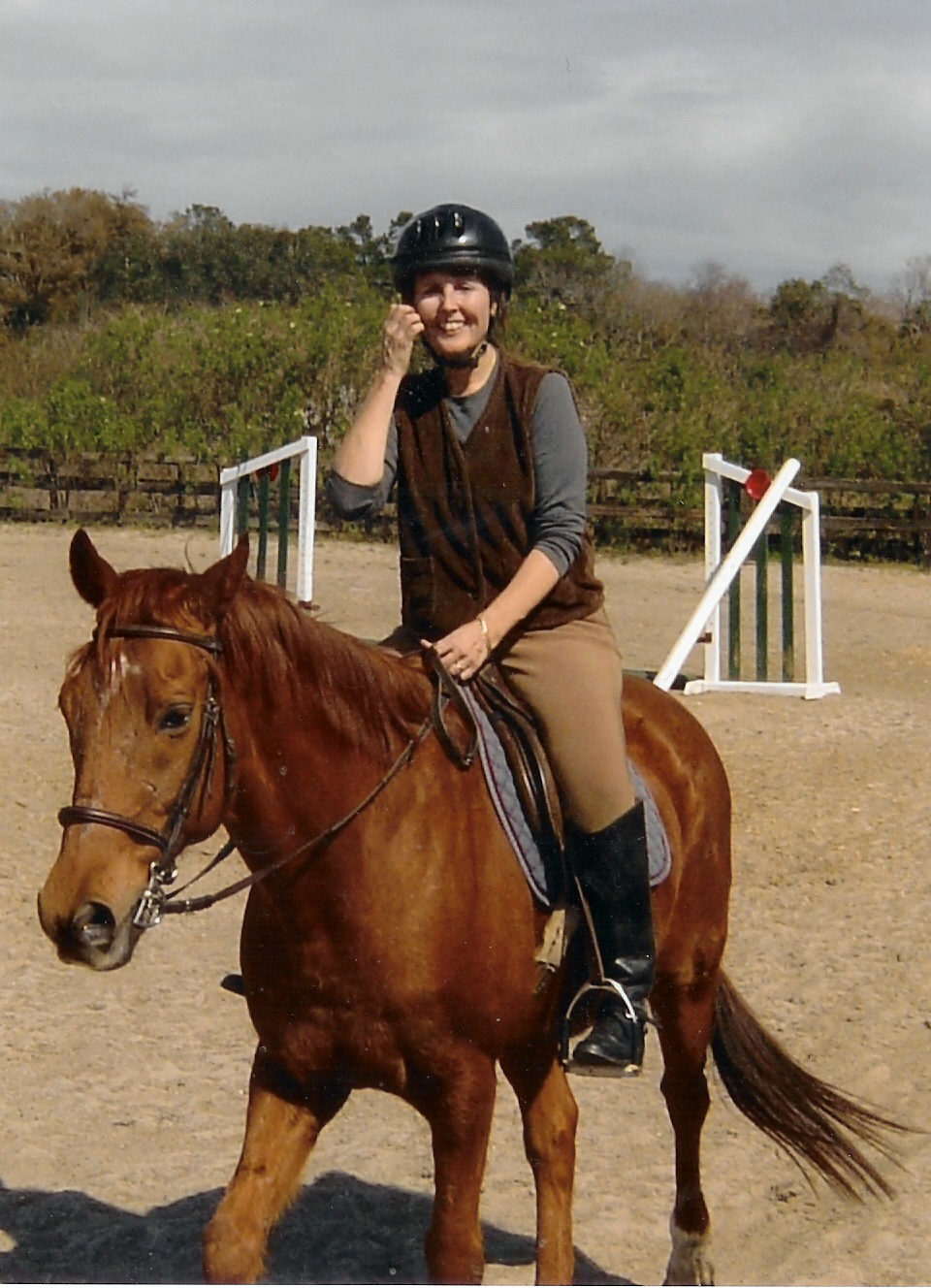 wanted to make today is that when you are sorting out your life, the process is a lot like riding a horse in that you, as the rider, really must look where it is you want to go. Ideally, this is right through his set of ears like a kind of organic scope. You don’t look at the ground, obviously, although new riders often do because they want to make sure everyone’s feet are going where they should. But looking at the ground is a great way to end up there.
Riding a horse–like living your life–is a delicate balance. You are not just a sack of feed up there for the ride (or at least ideally not.) When you turn your head, the horse feels it, the horse reacts even if just a little bit. If you are looking down, instead of up, or to the left, instead of to the next line of jumps, that’s where the horse is now looking too. Which, since that’s not where you want to go, looking over there is not a good thing.
Kristen Lamb has this section in her book Are You There, Blog? It’s Me, Writer where she interviewed some NASCAR drivers for a piece she was doing and they, basically, told her they try not to look at places they don’t want to go…like the wall, for instance. It seems that in professional driving as in life and in horseback riding, it’s important to zero in on where you’re going.
Like I said, I love it when universal truths really are universal.
 Susan Kiernan-Lewis